


"ALL WE ARE TRYING TO DO IS SURVIVE"
- 1 day ago
- 7 min read
Updated: 8 hours ago
Inside the fight to save Haitian TPS holders from deportation

Photo courtesy of Miami Music Project | Students from the Little Haiti Chapter celebrate Haitian Flag Day through music, storytelling, and dance.
Marie remembers the excitement of her first weeks in America. She can still recall the feeling, after everything she'd survived, that she had finally reached the safest place she could be. Those memories now sit beside a different mental image: recurring nightmares of being back in her homeland.
"I don't want to go back to Haiti," said the Florida mother of three, who asked to be identified by an assumed name to protect her family's safety. "I'm afraid to go. I have a lot of nightmares when I see I am in Haiti."
Marie came to the United States after surviving the 2010 earthquake that devastated Haiti and killed her brother. Before the disaster, she worked as a teacher for children with learning difficulties and volunteered with her Seventh-day Adventist church, helping adults learn to read and leading public health outreach on preventable diseases. After the earthquake, she joined rescue and reconstruction efforts in her community.
Around 2015, Marie became involved in Haitian politics. A supporter of the opposing political faction began harassing and intimidating her and, after the election, physically assaulted her because she continued backing the opposing candidate. Fearing she could be killed, Marie fled to the United States from Haiti.
Today, Marie is a certified nursing assistant in Florida, caring for the sick and elderly. She is also the mother of three American-born children, including a pair of five-year-old twins and a seven-year-old, all of whom are autistic and require specialized care.
For years, Marie has held Temporary Protected Status, or TPS, a legal designation the federal government gives to people already in the United States and who come from countries in the midst of armed conflict, natural disaster, or other extraordinary crises, allowing them to live and work in the country legally until conditions improve.
A person cannot receive TPS unless they are already in the United States. TPS offers no path to lawful permanent residency or citizenship. Instead, holders of the status must pursue a separate route, such as asylum, family-based petitions, employer sponsorship, or other protections if they want to stay in the country permanently.
Haiti was first designated for TPS in 2010 in the wake of that year's earthquake. The designation was extended repeatedly over the next several years, until the Trump administration announced its termination in 2019, a decision that court injunctions subsequently blocked.
In 2021, Secretary of Homeland Security Alejandro Mayorkas issued a new TPS designation for Haiti, citing the country's political instability and gang violence. That designation has since been extended and redesignated twice.
Now, Haiti TPS protections are set to disappear. The Supreme Court has cleared the way for the Trump administration to terminate TPS protections for Haitians and Syrians.
Over 350,000 Haitians are now facing the possibility of being deported to their homeland, which will expose them to life-threatening danger amid the country’s ongoing crisis. Nowhere will the impact be felt more than in Florida, home to the largest concentration of Haitian TPS holders in the country. State figures show roughly 158,000 Haitian TPS holders live in Florida, a number that has more than quadrupled since 2021. In the Miami metro area alone, there are an estimated 90,000 Haitian TPS holders, roughly equal to the combined total in New York, Massachusetts, New Jersey and Pennsylvania.
Like Marie, TPS holders from Haiti have lived and worked lawfully in the United States for years, undergoing repeated background checks and biometric vetting every time they renewed their status.
"TPS ending will affect not only parents, it will affect millions of children who have been born from an immigrant who has TPS, and the children are American," Marie says. "They deserve to live free. They deserve to have a good life. Give them that opportunity to not be in foster care, or to not be in the street."
"Every Case Is an Emergency Room Case"
Marie is one of many people represented by Americans for Immigrant Justice (AI Justice), a Miami-based nonprofit that has provided free legal representation to low-income immigrants for the last thirty years. As TPS protections end, the organization has taken on a larger share of cases, even as other resources shrink.
Sui Chung, executive director of AI Justice, says the ruling could not come at a more dangerous moment. Immigration enforcement in Florida has intensified sharply under the Trump administration. U.S. Immigration and Customs Enforcement (ICE) has arrested growing numbers of people with no criminal record while Florida has expanded 287(g) agreements – deputizing local police and sheriff's departments to carry out federal immigration duties – more aggressively than almost any other state. These measures have resulted in a 2,450% increase in non-criminal immigration arrests, according to the American Immigration Council. Losing TPS now, Sui says, means even a routine traffic stop can end in immigration detention.
"We've entered a different universe of what enforcement looks like," she said. "Our Haitian community is particularly vulnerable in the state of Florida because of 287(g) agreements that allow state and local law enforcement officers to enforce federal immigration laws."
That shift means AI Justice is attending to more cases that require an urgent intervention.
"Every case is an emergency room case," Sui said. "Everyone could be subject to arrest right now."
The crisis has significantly impacted AI Justice’s ability to assist those affected. Their detention hotline received more than 20,000 calls in 2025 alone – incredibly, the organization was able to respond to only 13,300 of those – providing what is often the only source of legal help for people held in Florida's eight immigration detention centers. Sui says AI Justice covers all eight immigration facilities statewide, while other providers might attend toanage one or two. Callers routinely tell AI Justice staff that "nobody else picks up the phone."
The economic stakes are just as high. Haitian TPS holders contribute an estimated $2.6 billion annually to Florida's economy, paying more than $606 million in combined federal, state and local taxes each year. That’s according to data from FWD.us, a policy organization working to advance better and more politically resilient solutions on immigration.
Nationally the figure climbs to $5.9 billion a year, with 200,000 Haitian TPS holders working in industries from agriculture to nursing care. Nearly 70% of Haitian immigrants in the United States are employed, a rate that is rarely acknowledged in the public debate over immigration.
"These are individuals who have already been vetted," Sui said. "They're not a danger to the community, so they should not be priorities for enforcement."
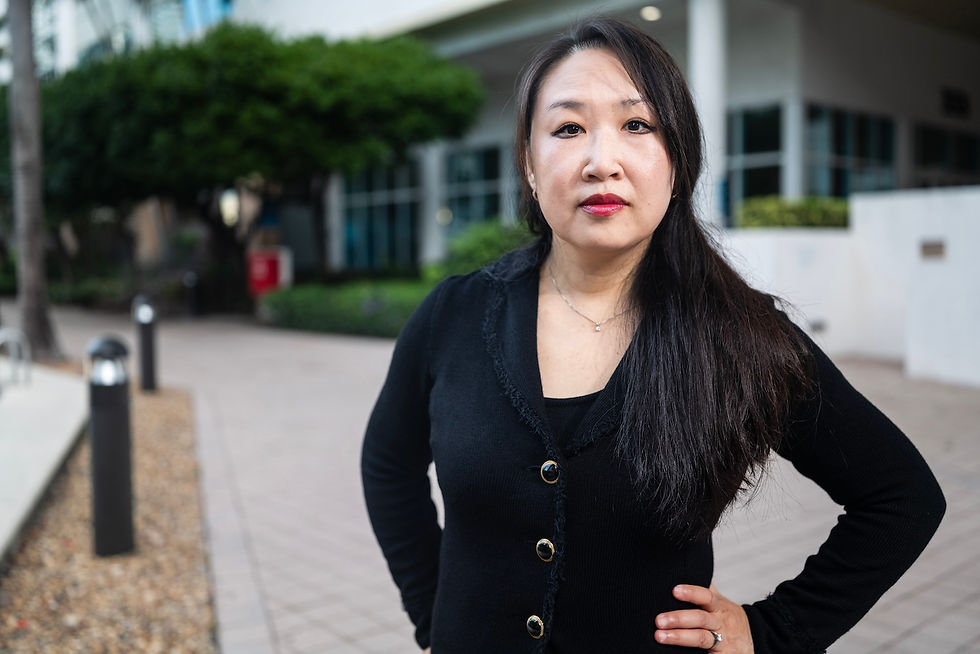
Sui Chung of Americans for Immigrant Justice outside the Miami Immigration Court | Photo by Greg Clark
Fighting the Clock
Originally called the Florida Immigrant Advocacy Center, Americans for Immigrant Justice was founded in 1996 by Cheryl Little alongside Sister Maureen Kelleher and Sister Catherine Cassidy. Little led the organization for more than 25 years before Sui Chung took over as executive director in 2024.
Sui is the daughter of a Korean immigrant physician who came to the United States for medical training and later served an underserved rural community in need of healthcare professionals. Before joining AI Justice, she spent years as an immigration defense attorney, an experience that continues to shape how she approaches every case. In the Haitian families AI Justice represents today, she sees reflections of her own family’s story.
"We need the Haitian community in Florida, and we need immigrants’ support and contributions. It is a tremendous loss to entire communities when they're forced to leave," said Sui.
Her colleague Reunie Faustin, also the daughter of immigrants, is an AI Justice family defense staff attorney working on Marie’s case. For the past two years, she has pursued a separate legal pathway through the Violence Against Women Act (VAWA), which allows survivors of domestic abuse to petition for legal status independently of a spouse.
"She now has an avenue for protection, which she didn’t have before," Reunie says of the ongoing application, which gives Marie the ability to pursue relief through both the immigration court system and directly through U.S. Citizenship and Immigration Services.
Reunie says the strength she sees in her Haitian clients, many of whom have waited more than two years just for a decision on a work permit renewal, has left a lasting impression.
"What they're focusing on is what they can control. That means caring for their children and families, working while they still have permits, and ensuring financial stability,” Reunie added.
"It is hard to still stay resilient, and it is hard to stay hardworking when it feels like everything is just being stacked on top of you."
What Comes Next
For Haitian TPS holders without a pending legal case – no family petition, no humanitarian protection application, and no other pathway – the termination leaves few options besides voluntary departure or the risk of arrest and detention.
Advocates say the situation in Haiti makes return especially dangerous. A March 2026 report by the Institute for Justice and Democracy in Haiti documented more than 8,000 killings and nearly 1.5 million people displaced in 2025 alone, alongside a near-total collapse of the country's police and court systems.
Sui says that AI Justice continues to accept new cases within its capacity, prioritizing detained individuals, unaccompanied children, and survivors of crime and human trafficking. But funding constraints, including the pause to a significant grant from the organization's largest funder, as well as threats to federal funding tied to the representation of minors alone in the U.S., have narrowed who the organization can assist.
For people like Marie, stuck in limbo between a homeland in tatters and a government that doesn’t seem to want her, the new obstacles to living a normal life in the United States can feel all too cruel.
"We didn't kill, we didn't steal, we didn't do anything wrong. All we are trying to do is survive.”


Comments