


GROWING IN GLASS
Updated: Apr 3
A collaborative effort turning discarded glass into a tool for coastal recovery
By Paloma Pimentel, Yulia Strokova

Juliana Grilo & Nathan Rubin
On the rooftop of the Frost Science Museum, rows of sea oats sway gently in the wind, rooted not in beach sand but in what was once discarded glass.
What may appear to be a quiet experiment is, in fact, a purpose-driven collaboration between scientists, students, and local innovators, one that could reshape how coastal communities restore and protect their shorelines.
When the project began taking shape in December 2025, each piece quickly and seamlessly fell into place, said Juliana Grilo, program manager for the Museum’s Volunteers for the Environment (MUVE). They identified a company managing their café’s glass recycling program, Glass for Life.
When she reached out to purchase their glass, she was surprised to learn that the company had already been developing plans for a study using glass sand for plant restoration.
“They had already been working with undergraduate students from UM and just needed space to conduct the study. So we provided that,” Juliana said. “It all happened super fast.”
That sense of alignment between research, community need, and available resources quickly transformed an idea into a living experiment.
In the project’s early stages, 1,950 white glass bottles, donated by the Coconut Grove hotel Mr. C, were transformed into 64 gallons of sand.

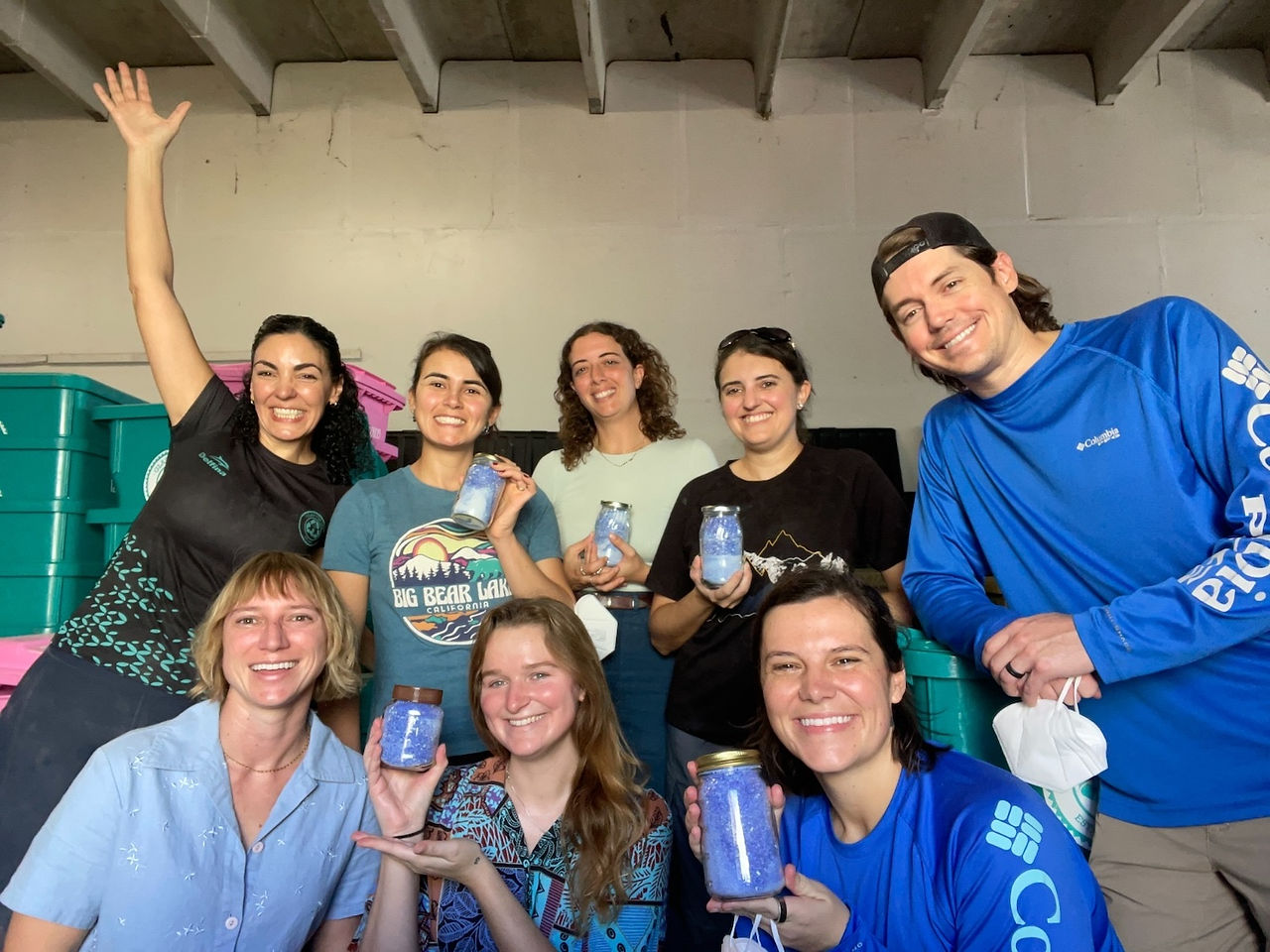
Juliana Grilo, Paola Barranco, Francisco Torres & Cameron Bogle
Led by Paola Barranco, co-founder of Glass for Life, the team carefully matched the grain size of local beach sand, ensuring the glass sand was structurally indistinguishable and equally capable of supporting root growth.
Barranco also noted a potential advantage of glass sand: it is cleaner and more uniform in size and composition than natural beach sand.
“Glass sand can contain small amounts of contamination because it’s recycled, but so does beach sand,” she said. “We actually had to clean the beach sand because it contained metals, trash, and plastic. Ultimately, our glass sand was cleaner.”
With financial and logistical support from the hotel, the study was brought to life on the roof of the museum’s sustainability building. There, scientists are testing whether glass sand can help restore coastal ecosystems by planting sea oats, a preferred restoration species whose extensive root systems anchor sand and promote biodiversity, both essential to the ecosystem’s health. The plants are being grown in four different types of sand beds: beach sand, glass sand, a combination of the two, and a mixture of sand and compost.
The University of Miami has contributed volunteers, undergraduate students from various disciplines, who helped assemble the study and are continuing to collect data. Each Sunday morning, they return to monitor the sea oats and measure their growth across the four sand mixtures. The study was set to run for 90 days, concluding in March.
One student in particular, Nathan Rubin of UM, has been recognized both for streamlining the project and for advocating for ecosystem preservation and sustainably growing the economy.
“This study could help coastal communities protect their land and resources, and truly make a difference,” said Nathan, the study’s volunteer leader.
The Naples native became interested in the study after seeing how his hometown imported sand from the Everglades to replenish its beaches, which were depleted by hurricanes. The manner in which the city chose to prioritize its tourism-driven economy at the expense of the environment gave him pause.
“It’s not sustainable,” he said. “I want to make sure my community has income, but not at the expense of another ecosystem.”
Florida’s beaches have experienced persistent sand loss over the past decade, driven by rising sea levels, stronger hurricanes, and human alterations to coastal infrastructure. Reports indicate that sourcing sand from places like the Bahamas for beach renourishment can place environmental strain on those regions.
Environmental sustainability is at the core of the study, which aligns with the United Nations’ Sustainable Development Goal 14, “Life Below Water,” according to Rubin. The project contributes to protecting and restoring marine and coastal ecosystems by testing sustainable materials and expanding scientific understanding of marine health.


Photos courtesy of Lauren Reilly
“It’s a great example of circular design, turning waste material into something usable and beneficial for the environment,” said Lauren Reilly, a naturalist with expertise in environmental science, mapping, and advocacy.
As founder of Sustainable Spin, Lauren is collaborating on a voluntary basis with the research team to document the study and translate its findings into engaging, accessible formats.
“It’s inspiring to see the community come together to develop solutions that meet multiple environmental needs.”
During her time with the team, Lauren has observed how compost enhances plant growth, noting that wild sea oats often lack sufficient nutrients to thrive.
“What we’re learning from this study is how many natural nutrients are lacking in our sand dunes. You can actually see it in the coloration of the leaves,” she says.
“The sand as a growing medium, whether natural or artificial, is effective. It provides the structural base for plant growth, but it’s the nutrients in the soil that truly sustain the plants.”
After graduating from the University of Miami’s Rosenstiel School with a master’s in Coastal Zone Management, Lauren became concerned about the gap between scientific research and public understanding. She founded initiatives focused on sustainability, using storytelling, mapping, and creative formats to raise awareness and inspire action.
Early findings appear to support the hypothesis that glass sand, especially when combined with compost, can significantly increase coastal ecosystem productivity.
“The difference between the bed with compost and the other three is outstanding,” she said. “With just a little compost, the life, the color, the strength, it all improves dramatically.”
She added that glass sand is proving just as effective as beach sand in supporting ecosystems. While both materials naturally lack nutrients, they can be enhanced with compost to sustain plant life.
The next phase of the project will explore whether other plant species can thrive in a sand-and-compost mixture. The study is expected to move to a beach setting, where researchers can reach more definitive conclusions.
“Compost contains a lot of life,” Paola Barranco noted. “We need to understand how to manage that and whether other species might emerge.”
This study adds to a growing body of research, including coastal restoration trials in Florida and the Caribbean, as well as laboratory studies on glass-based substrates, showing that recycled glass can support plant restoration in coastal environments.
Because it can be engineered to closely match the composition and grain size of beach sand and enhanced with nutrient-rich components such as compost, it presents a promising supplement.
If the study proves effective, Paola hopes to scale production and offer glass sand to the city as a sustainable solution for strengthening coastal ecosystems.
“We want to prove that we can restore ecosystems with glass,” she said. “Instead of extracting sand from other environments, we can use the glass we are currently sending to landfills.”


Comments