


SMALL GIFTS, COLLECTIVE POWER
This community-driven giving circle proves that small investments can create big impact

Photo by IMAGE.Miami
If you had $100 to help make your community a little better, where would you choose to give it?
Sometimes, the most meaningful change does not begin with billion-dollar checks or large institutions, but with a room full of people asking the same question and choosing to act together.
“One person can give $100. But 150 people giving together? That’s real change,” says Dara Schoenwald, ocean activist and co-founder of the nonprofit organization Volunteer Cleanup.
In early 2020, just as the world shut down, Dara stepped in to help build the Miami Beach chapter of 100 Women Who Care.
“Everything was virtual, and yet we still managed to reach critical mass.”
The idea behind the movement is simple, yet powerful. When 100 women come together, each contributing $100, they can raise $10,000 for a local nonprofit in just one hour. Often, that impact grows even further through matching grants from partner foundations.
Today, with nearly 150 members, the Miami Beach chapter distributes around $15,000 every quarter. For nonprofits operating on small or restricted budgets, a single grant can fund a program, expand services, or stabilize operations during a critical moment.
“We’re not trying to fund organizations that already have access to millions,” Dara continues. “Our focus is grassroots nonprofits where $15,000 can truly change everything.”

Dara Schoenwald | Photo by IMAGE.Miami
Where the Story Began
The idea itself took root years earlier with Kim Rodstein, a real estate professional whose relationship with philanthropy shifted by chance while serving on the board of a South Florida horse rescue. One day, her organization received an unexpected $10,000 donation from a giving circle.
The experience planted a seed. Years later, Kim came forward with a plan to co-found the Miami Beach chapter. The hyperlocal model resonated immediately.
“It’s collaborative, transparent, and deeply respectful of the work organizations are doing on the ground. You don’t just give money. You see where it goes. You hear the stories. You can visit the organizations. That builds trust.”
The work of 100 Women Who Care shows that meaningful impact does not require enormous wealth, only intention, consistency, and community.
Over time, the chapter has supported a range of grassroots organizations, including Embrace Girls Foundation, which empowers girls through mentorship and education; ICU Baby, providing critical support to NICU families; and No More Tears, assisting survivors of human trafficking and domestic violence.
It has also backed Favela Miami, helping individuals exit homelessness through job training and pathways to stable housing, as well as 305 Pink Pack, which provides transportation, child care, and other essential services at no cost for adults undergoing cancer treatment—so they can focus on healing and spend time with their families.
With more than 3,000 local nonprofits across Miami-Dade, the giving circle opens members’ eyes to needs they may never have known existed.
“That’s the real giving,” she reflects. “You’re coming together collectively and waking up to what’s happening around you.”
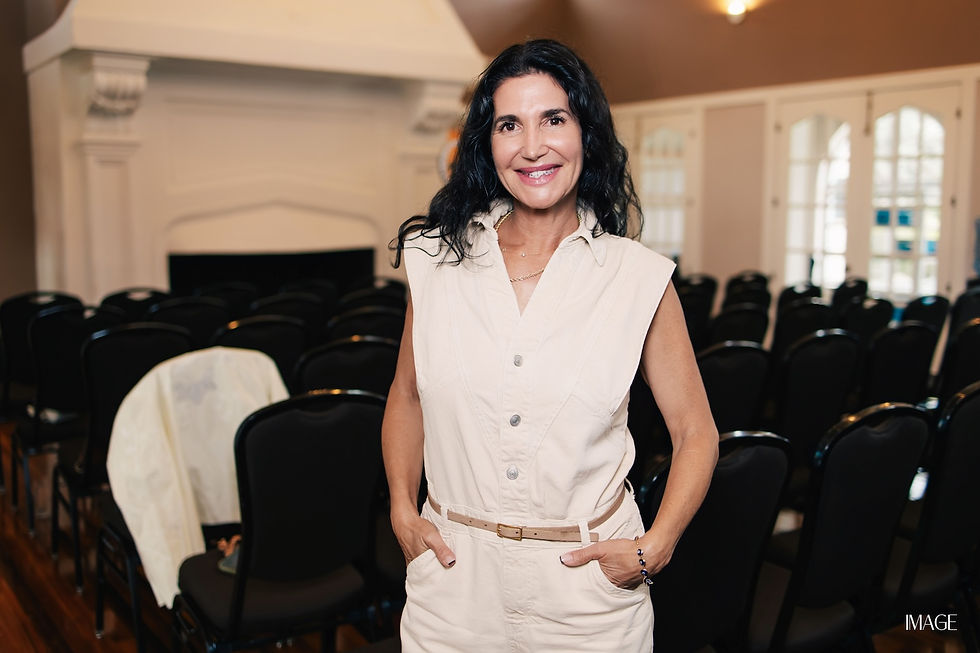
Kim Rodstein | Photo by IMAGE.Miami
Collective Giving
The idea of collective giving has deep roots in mutual aid and community-based philanthropy, but the modern giving circle movement in the United States began gaining traction in the late 1990s and early 2000s as donors sought more participatory alternatives to traditional giving. Over the past two decades, the giving circle movement has expanded to more than 2,000 circles, engaging approximately 150,000 people and directing nearly $1.3 billion to charitable causes.
Each quarter, members are introduced to three organizations. Nonprofits are selected months in advance, giving them time to prepare thoughtful, story-driven presentations. Only members can nominate organizations, creating a peer-to-peer system rooted in lived connection.
For Mirielle Enlow, a co-founding member with more than 30 years of experience in real estate, discovery lies at the heart of the experience. Mirielle meets with nonprofit leaders ahead of their presentations.
“Those five minutes matter,” she explains. “In the past, people sometimes used their five minutes like they were writing a grant: lots of data, lots of numbers, sometimes boring information. We wanted them to tell stories, because that’s what really helps our members understand the work.”
One moment has stayed with her. When Kathie Klerreich, founder of Exchange for Change, came forward to pitch her organization, which supports people impacted by incarceration through education and literacy, Mirielle helped her prepare.
“She said to me, ‘I really appreciate you taking the time, but nobody ever votes for convicts,’” Mirielle recalls. “I almost started crying.”
Mirielle encouraged her to shift that mindset and walk in believing that her work was just as worthy as anyone else’s. Kathie did, and she won.
“I’ve never seen anyone cry like that after winning,” Mirielle says. “She couldn’t believe people chose her. And I think it changed how she sees her own work. Now she knows: people will vote for you.”
Moments like these reveal the deeper power of collective giving, not only to fund organizations, but to affirm their value and amplify their voices.


Photos by IMAGE.Miami
Room to Grow
For many women, participation becomes a gateway to volunteering, board service, or long-term advocacy.
Susan Askew, a seasoned entrepreneur and also a co-founding member of chapter, describes the group as both intimate and expansive. “We’re a group of dynamic women who share a passion for Miami Beach and for contributing both our time and our money,” she says.
Susan sees particular opportunity in deeper partnerships. “We already have a matching grant from one foundation,” she notes. “It would be exciting to develop more relationships like that.”
Terri Echarte, drawing on more than 30 years in real estate finance and banking, highlights the model’s flexibility: “We’re not asking members to do anything beyond the commitment to give.”
Meetings are uplifting but optional. No additional fundraising is required beyond the quarterly commitment. Digital platforms like Grapevine streamline donations, ensuring funds go directly to nonprofits.
For Terri, the motivation is simple:
“It’s important to give back. Most of us are grateful for the lives we have. This is about doing something tangible for people in our community who need these programs and services and knowing that 100 percent of the money goes directly to the nonprofits that need it most.”


Comments