


THE ANSWER IS US
- Dec 15, 2025
- 5 min read
Updated: Dec 17, 2025
What COP30 actually achieved for forests and Indigenous people?
By Leslie Ramos

Within a just-completed convention center in the Brazilian city of Belém, beadwork, feathers, and body paint stood out among a sea of grey suits and slickly-produced pavilions. At the 2025 United Nations Climate Change Conference (COP30), leaders from Brazil’s Indigenous nations passed pieces of the Amazon through a security checkpoint, from hats and skirts made of woven palm leaves to an actual squirrel monkey. Their appearance against the glow of LED screens, flying by like a flock of macaws, was jarring to say the least.
Situated where the Amazon River meets the Atlantic Ocean, Belém was strategically chosen by the Brazilian government as the host city of COP30 in order to make the climate conference more accessible to the over 400 Indigenous tribes that inhabit the Amazon basin.
The communities who safeguard the world’s last wild places have too often been missing from the rooms where their futures are debated. COP30 changed that: With travel supported by river access and accommodations provided at the Indigenous Village (Aldeia COP), more than 3,000 representatives from across Brazil arrived in Belém to claim their place at the negotiating table. No climate summit had ever welcomed such a large delegation before, and their presence shifted both the atmosphere and the agenda.


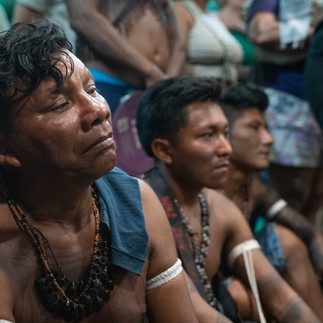


At the Indigenous Peoples Pavilion, an enclave within the official delegate zone devoted to amplifying Indigenous voices from around the world, the air buzzed with a blend of languages carrying stories from far away lands. Leaders spoke of water contamination and deforestation driven by mining and other extractive industries, returning again and again to a shared truth: “Nós somos a resposta.” (“The answer is us.”)
“We have a great common enemy,” said Cacique Ninawa, a member of the Amazon’s Huni Kuin tribe. “And it is Big Capital.”
“We are protectors,” said Arassari Pataxó, a leader of the Pataxó people from the northern Brazilian state of Bahia. “Nature is no one’s private property, she is our mother.”
Pataxó’s words point to the heart of the Indigenous worldview: the Earth is a partner to honor, not an asset to exploit. Where his people see relatives, corporations see revenue streams.
Globally, extractive industries are clearing forests at staggering rates to make way for mining operations and vast monocultures like soy and cattle ranching, the two biggest drivers of deforestation in Brazil. Between 2000 and 2020, Brazil alone lost an amount of primary forest equal to the total land area of France. And while new advances in energy generation and storage may help decarbonize our economies, the empowerment of Indigenous nations can meaningfully protect what remains.

There are approximately 476 million Indigenous people in the world. Although they represent only six percent of the global population, they are responsible for protecting and managing hundreds of millions of hectares of land, safeguarding much of the biodiversity that remains. Almost 40 percent of the planet's intact forests are located in Indigenous territories, where deforestation rates are consistently lower than in areas protected by states alone.
Ahead of COP30, Sônia Guajajara, Brazil’s Minister of Indigenous Peoples and the first Indigenous woman to hold a cabinet position in the country, made a forceful appeal to world leaders. She called for full legal recognition of Indigenous territories, an urgent demand that would shift conservation authority into the hands of the peoples who have safeguarded these lands for millennia.
Sônia Guajajara leads The People’s Circle, a new COP30 initiative backed by the International Indigenous Commission, designed to place Indigenous rights and stewardship at the center of global climate policy.
“The evidence is clear,” she wrote in an open letter. “Where Indigenous territorial rights are respected, deforestation declines; where they are denied, destruction advances.”
Her message set the tone for the entire COP30 and underscored what scientists, NGOs, and now policymakers increasingly acknowledge: Indigenous governance is not only a cultural imperative, but a proven climate solution with global consequences.



CAUTIOUS OPTIMISM
While negotiators once again failed to produce a binding fossil fuel phaseout roadmap, and financing for climate change adaptation remained deeply insufficient, newly adopted policies could deliver some of the most effective forest protection on Earth.
In a landmark act of diplomacy, the governments of Brazil, Colombia, Costa Rica, Ecuador, Fiji, Indonesia, and the Democratic Republic of the Congo endorsed a global pledge to secure the land rights of more than 160 million hectares of Indigenous, local, and Afro-descendant territories by 2030.
Brazil carries the largest share of that commitment — 63 million hectares, an area roughly the size of Texas — alongside the formal demarcation of ten new Indigenous lands, a process requiring technical validation by federal agencies and final approval by presidential decree to grant communities definitive legal title.

COP30 also introduced the Tropical Forest Forever Facility, a groundbreaking payment-for-performance model that rewards countries for every hectare of forest they conserve. With a collective $5.5 billion investment, the TFFF investment fund is aimed at keeping rainforests standing. It was launched with a mandate to direct at least 20 percent of its financing straight to Indigenous and local communities, ensuring they receive tangible benefits for keeping forests standing.
Another major step is the creation of a Just Transition mechanism, a framework designed to ensure the shift to a green economy uplifts women, workers, and forest-based communities who are too often marginalized.
Known as the Belém Action Mechanism (BAM), it commits countries to cooperation on technical assistance, capacity-building, and shared knowledge to overcome existing barriers to a fair transition. The Climate Action Network described it as “one of the strongest rights-based outcomes in the history of the UN climate negotiations.”
For the first time, the just transition text delivered strongly on Indigenous rights, including free, prior, and informed consent; self-determination; and recognition of the rights of Indigenous Peoples in Voluntary Isolation and Initial Contact.
As Climate Action Network International Executive Director Tasneem Essop, put it,“This outcome didn’t fall from the sky; it was carved out through struggle, persistence, and the moral clarity of those living on the frontlines of climate breakdown…Anything less is a betrayal of people and of the Paris promise.”
THE ETHICS TRANSITION
In 2015, the world celebrated the Paris Agreement as a landmark in the global fight against climate change. The principle of “leave no one behind,” carried over from the Sustainable Development Goals, was recognized as a core ethical foundation of the agreement. It represented values of equity, inclusiveness, and justice, ideas essential to tackling both the causes and consequences of climate change.
Yet, in the years that followed, these values drifted into the background, as implementation focused largely on emissions targets, market mechanisms, and national reporting frameworks, often sidelining the lived realities of frontline communities.

Now, in 2025, Brazil introduced the Global Ethics Stockade (GES), putting ethics squarely back at the heart of international climate cooperation. Through the GES, communities around the world are invited to collectively define what is right and just in this moment of planetary transformation.
What began as self-organized dialogues is now a practical resource for anyone seeking to spark ethical conversations locally. Available in Portuguese, English, and Spanish, the guide offers culturally grounded prompts such as:
What wisdom from your community teaches harmony with nature? How do we cultivate responsibility — not only innovation? What values must guide the transition ahead?The guide emphasizes creating welcoming spaces for listening, empathy, and expression, often through art and culture, out of a belief that solutions deepen when everyone is seen and heard.
COP30 showed that integrating ethics and Indigenous knowledge can ground progress in purpose. But it also underscored a truth long denied: the climate crisis is fundamentally a moral crisis, defined by the tension between profit and planetary survival.
As Pataxó reminded, “It’s not money that will solve the climate crisis. It’s consciousness, love, and respect.”

Arassari Pataxó
This article and our reporting from COP30 are supported by The VoLo Foundation. We’re deeply grateful to our partners who help us bring meaningful stories to life.


Comments